

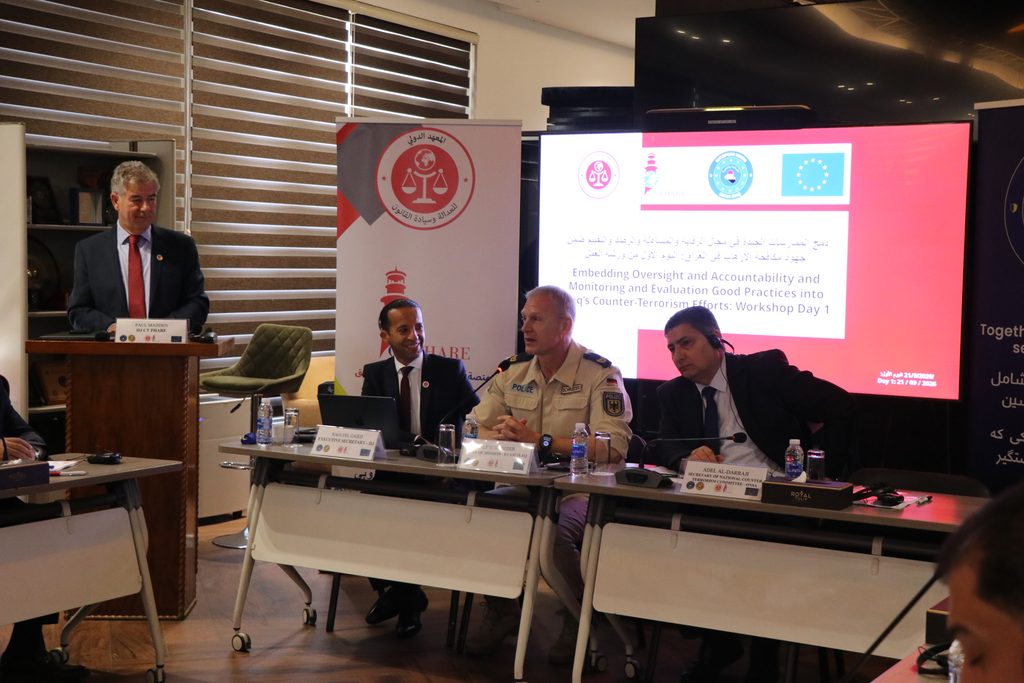
From 21-23 September 2026, the International Institute for Justice and the Rule of Law (IIJ), through its Counter-Terrorism Platform for Human Rights Engagement (CT PHARE), with generous funding from the European Union, convened a three-day activity in Baghdad, Iraq, in coordination with the European Union Advisory Mission in Iraq (EUAM Iraq) and at the request of the Office of the National Security Advisory (ONSA), on embedding oversight and accountability and monitoring and evaluation good practices into Iraq’s counter-terrorism efforts. The activity brought together 27 representatives of Iraqi ministries, the Supreme Judicial Council, the National Centre for International Judicial Cooperation (NCIJC), security and intelligence agencies, Office of High Commission on Human Rights, academia, and governorates, one third of them women, and was the final activity of the CT PHARE project.
The activity supported the operationalisation of the Global Counterterrorism Forum (GCTF) Brussels Memorandum on Good Practices for Oversight and Accountability Mechanisms in Counterterrorism Operations through a self-assessment of oversight and accountability practices, followed by discussions on next steps. It emphasised a human rights-based approach to data, monitoring, and evaluation within Iraq’s counter-terrorism strategy, national priorities, and UPR commitments.
The opening featured remarks from Mr. Adel Al-Darraji, Secretary of the National Counter-Terrorism Committee – Office of the National Security Advisory; Mr. Ralf Schröder, Head of Mission, European Union Advisory Mission in Iraq (EUAM Iraq); Mr. Naoufel Gaied, Executive Secretary, IIJ; and Judge Anwar Hassan of the Supreme Judicial Council.
Prof. Ben Saul, UN Special Rapporteur on the promotion and protection of human rights and fundamental freedoms while countering terrorism, delivered a keynote address to participants by video message. He commended the Brussels Memorandum as a practical tool for strengthening national human rights protection, and stressed that oversight and accountability mechanisms must be genuine and effective rather than cosmetic, able to ensure substantive compliance with international human rights law, and supported by a wider environment of rule of law and good governance. He also highlighted that effective oversight strengthens national security by building public trust, preventing violations that can themselves be conducive to terrorism, and enabling lawful international cooperation.
The first session introduced the GCTF Brussels Memorandum, followed by an interactive exercise mapping oversight mandates. Participants then explored oversight in the strategic context, focusing on Good Practices 10 and 13, including the role of oversight in implementing the new counter-terrorism strategy, coordination mechanisms, and the mapping of strategic roles and partners. The first day concluded with institutional briefings, in which participants identified their institutions’ counter-terrorism responsibilities and developed short internal awareness-raising briefings.
On the second day, participants worked in small cross-institutional groups to self-assess their institutions against selected good practices, starting with the remit of oversight mechanisms (Good Practice 2), including a recap of the good practice, a practical task, and a plenary restitution.
Participants then examined oversight mechanisms’ access mandate (Good Practice 4) through a recap of the good practice, an institutional self-assessment on access mandates, and a plenary discussion. Public complaints mechanisms (Good Practice 7) and protection against reprisals (Good Practice 8) were then addressed together in a single exercise, given their overlap, combining a review of the relevant good practices with institutional self-assessments and plenary restitutions to support reflection on national oversight frameworks. In his closing remarks for the day, CT PHARE Project Lead Mr. Paul Madden presented the IIJ toolkit on the protection of witnesses and criminal justice officials, developed with the GCTF Criminal Justice and Rule of Law Working Group.
The final day focused on transparency practices (Good Practice 11), beginning with discussions on transparency as a strategic tool and the application of a human rights-based approach to data, followed by an institutional self-assessment and plenary restitution. Participants also explored human rights expertise and training (Good Practice 12), examining the role of oversight within the international human rights framework and assessing institutional capacities in this area.
The activity concluded with discussions on embedding oversight and accountability into the implementation of Iraq’s new counter-terrorism strategy. Participants’ consolidated recommendations to include clarifying the mandates of the new Human Rights Directorates in each Government Ministry, legislating oversight bodies’ access to information and places of detention, standardising complaints handling, funding witness protection, and publishing non-sensitive information on the National Counter-Terrorism Strategy. The IIJ will translate the recommendations into Arabic and share them with ONSA for validation by participants before they are finalised. Closing remarks were delivered by ONSA, EUAM Iraq, and the IIJ, and the activity closed with the presentation of certificates.