

From 22 to 23 April 2026, the International Institute for Justice and the Rule of Law (IIJ), through its EU funded Counter-Terrorism Platform for Human Rights Engagement (CT PHARE), convened a joint workshop in Cairo, Egypt with the League of Arab States (LAS) Department of Counter-Terrorism. The workshop was organised in collaboration with the European Union (EU), and with the participation of international partners, including the United Nations Counter-Terrorism Committee Executive Directorate (UN CTED) and the Office of the United Nations High Commissioner for Human Rights (OHCHR) in New York.
The workshop, titled “Integrating Preventing and Countering Violent Extremism Policies into National Counter-Terrorism Measures,” was organised within the framework of the EU-LAS partnership. It contributed to ongoing cooperation on counter-terrorism and preventing and countering violent extremism (P/CVE), in line with the outcomes of the EU-LAS Senior Officials’ Meeting (June 2025) and the work of the EU-LAS Working Group on Counter-Terrorism.
The event brought together LAS Member States, policymakers, practitioners, and experts, providing a platform to exchange knowledge, share national experiences, and identified recommendations to better integrate the prevention of violent extremism into national strategies in line with human rights standards.
Opening remarks were chaired by Mr. Ali Dabouz, Director of the Counter-Terrorism Department at the LAS General Secretariat; and delivered by Dr. Maka Bakhit, Director of the Legal Affairs Department at the League of Arab States; Mr. Nasser Al-Subaie, Head of the Arab Expert Group on Counter-Terrorism; Mr. Mohammed Al-Suhaili, representative of the Arab Interior Ministers’ Council; Mr. Khalid bin Abdulaziz Al-Harfash, Naif Arab University for Security Sciences; Mr. Dimitrios Karapatakis, Counter-Terrorism Expert at the EU Delegation to Egypt; Mr. Ahmed Essmat Seif El-Dawla, Chief of Section at UN CTED; and Mr. Paul Madden, Project Lead of IIJ CT PHARE.
Discussions were further enriched by contributions from H.E. Ambassador Abdullah M. Al-Zabidy, Executive Director of the European Commission -League of Arab States Liaison Office in Malta (ECLASLO).
Session One, chaired by the League of Arab States, focused on the key provisions of the 2022 Arab Counter-Terrorism Strategy related to preventing extremism. This was followed by a discussion on the practical requirements for effectively operationalising its first pillar, addressing the conditions conducive to the spread of terrorism. Contributions were delivered by Brigadier Mohammed bin Abdullah Al-Suhaili, Director of the Arab Office for Combating Extremism, Terrorism, and Cybercrime; Dr. Hisham Al-Ghannam, Director of the Security Research Center, Naif Arab University for Security Sciences; Dr. Alaa Al-Tamimi, Director of Research and Strategic Studies Department; and Ms. Noha Sobhi, Department of Culture and Dialogue of Civilizations.
Session Two, chaired by IIJ CT PHARE, featured contributions from two of its experts: Ms. Doreen Chen, an international human rights lawyer specialising in counter-terrorism contexts, and Mr. Daniel Hooton, Senior Advisor on Counter-Terrorism and P/CVE Policy and Strategy. They presented a case study on Iraq, highlighting technical support on how to integrate the prevention of extremism into the Iraqi national counter-terrorism strategy. The session concluded with an interactive discussion, during which several Member States of the League of Arab States raised questions, and Iraq underscored the inclusive nature of the support provided.
Session Three, also chaired by IIJ CT PHARE, examined methodologies for integrating the prevention of extremism into national counter-terrorism strategies from a global perspective. It drew on the mandate of UN CTED, with contributions from Mr. Ahmed Essmat Seif El-Dawla, alongside Ms. Seh Lih Long, Human Rights Officer at OHCHR, who joined online to present the OHCHR Toolkit on Strengthening Human Rights in Counter-Terrorism Strategy and Policy.
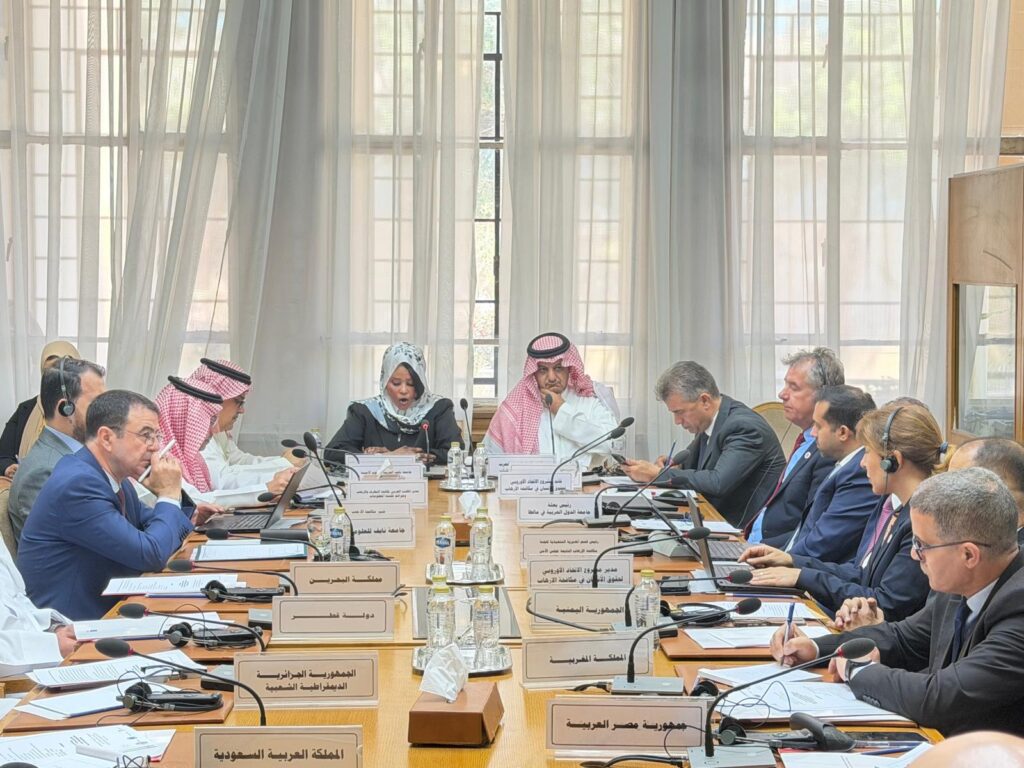
Session Four highlighted national good practices from Algeria, Egypt, Iraq, Jordan, Libya, Morocco, Tunisia, and Yemen, showcasing initiatives in rehabilitation, education, and youth empowerment.
The workshop concluded with a set of recommendations to be submitted to relevant bodies within the League of Arab States and its Member States, aimed at strengthening the regional and national frameworks for countering terrorism.